






If your business manufactures or imports packaged goods, your packaging decisions now affect more than just unit price and logistics. Under Extended Producer Responsibility, they also come with a future cost for waste collection, recycling and disposal.
This is where EPR cost modelling helps you stay in control, allowing you to forecast packaging compliance costs before you buy or approve packaging.
Extended Producer Responsibility shifts the cost of managing packaging waste away from local authorities and onto producers. If you place packaging on the market, you’re responsible for what happens to it at end of life.
For procurement teams, this changes the role of packaging completely. It’s no longer just a sourcing decision. It’s a long-term cost decision too.
In this guide, you’ll learn:
- What EPR cost modelling is
- How packaging EPR costs and fees are calculated
- What data you need from suppliers
- How packaging choices affect compliance costs
- How to reduce exposure through better procurement strategy
What is EPR cost modelling?
Extended Producer Responsibility is a regulatory framework that requires businesses to take financial responsibility for the packaging they place on the market.
EPR cost modelling is the process of estimating how much your packaging will cost to collect, recycle and dispose of before it’s placed on the market.
Instead of councils covering the full cost of waste management, producers now contribute to:
- Collecting packaging waste
- Sorting and processing materials
- Recycling or disposing of packaging
Modelling helps you forecast these packaging compliance costs early, so you can make better decisions before committing to a packaging format.
It allows you estimate:
- How much your packaging will cost to recycle
- How costs vary by material and weight
- How your packaging design affects EPR fees
- How future regulatory changes could impact costs
This is especially important for high-volume businesses, including EPR for manufacturers and EPR for importers.
Instead of comparing packaging options on purchase price alone, you can assess total lifecycle cost.
For example, two packaging formats might cost the same to produce. But one could carry significantly higher disposal fees due to weight or poor recyclability.
Why procurement teams need to model EPR costs
EPR has made packaging a procurement issue.
Most packaging decisions are made early in product development or supplier selection. These choices determine:
- Material type
- Packaging weight
- Recyclability
- Structural complexity
Each of these influences your sustainable packaging costs and long-term exposure to fees.
Without EPR cost modelling, you risk:
- Underestimating packaging EPR costs
- Selecting high-cost packaging formats
- Facing unexpected regulatory charges
With modelling in place, you can:
- Forecast packaging compliance costs accurately
- Compare suppliers and formats more effectively
- Identify high-risk packaging designs
- Align procurement with sustainability goals
Strong modelling usually involves multiple teams, including procurement, sustainability, compliance and finance. This joined-up approach leads to more effective packaging procurement strategy decisions.
How packaging EPR fees are calculated
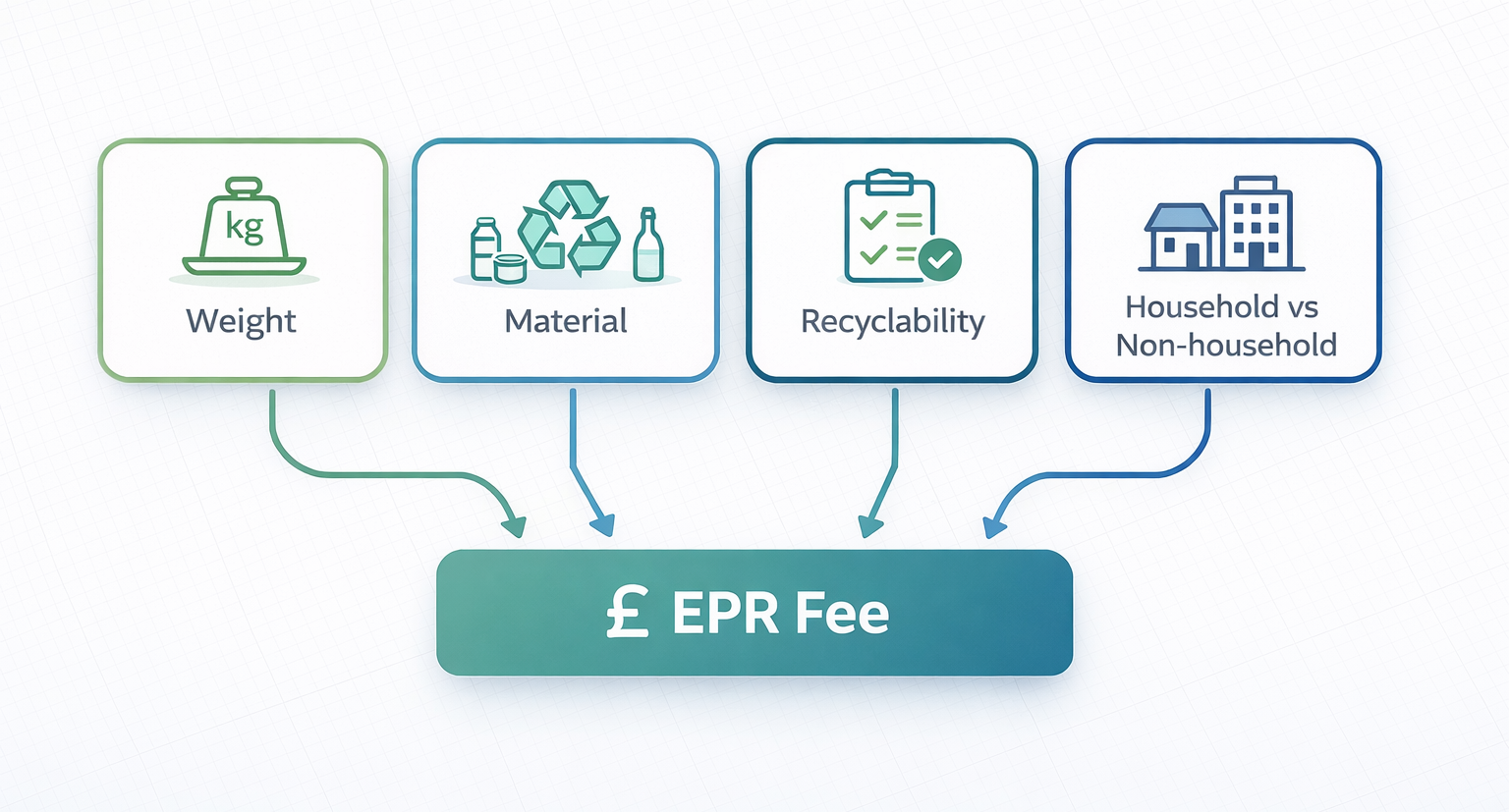
EPR fees are mainly based on weight, material type, recyclability and where the packaging becomes waste.
To model costs properly, you need to understand how EPR fees are calculated.
Packaging weight
Many systems use weight-based pricing.
The heavier your packaging, the higher your packaging lifecycle cost, because more material needs to be collected and processed.
Even small increases can have a big impact at scale:
- A 5g increase per unit can mean tonnes of extra material each year
- That increase feeds directly into higher compliance costs
Packaging material type
Different materials carry different recycling costs and values.
Common materials include:
- Plastic
- Glass
- Aluminium
- Steel
- Paper and cardboard
- Composite materials
Hard-to-recycle materials tend to have lower recyclability ratings and higher fees.
Household vs non-household packaging
Packaging is also categorised by where it becomes waste.
- Household packaging is disposed of by consumers
- Non-household packaging is generated in commercial settings
Household packaging waste fees are often higher due to collection complexity. These materials are typically managed through local authority systems, while commercial waste is handled through dedicated business waste and recycling services.
Recyclability ratings and modulated fees
Many EPR systems now apply modulated EPR fees.
Packaging is assessed using frameworks like the recyclability assessment methodology (RAM). Materials are rated based on how easily they can be recycled.
The ratings are as follows:
- Green for widely recyclable
- Amber for partially recyclable
- Red for difficult to recycle
Lower recyclability usually means higher fees.
What should procurement include in an EPR cost model?
A practical packaging EPR cost calculator starts with the right data.
For each product or packaging component, you’ll need:
- Packaging weight per component
- Material type
- Number of units placed on the market
- Recyclability rating
- Disposal fee per tonne
- Reporting and admin costs
A simple way to estimate cost is:
Estimated EPR cost per product = packaging weight × fee rate × annual volume
For example, a small increase in plastic weight can quickly scale into significant PRN and EPR costs when applied across large volumes.
To manage uncertainty, many businesses run different scenarios, such as:
- Reducing packaging weight
- Switching materials
- Testing alternative suppliers
- Modelling future fee changes
This helps you understand packaging total cost of ownership, not just upfront cost.
What packaging data procurement teams should collect from suppliers
Accurate modelling depends on accurate packaging data reporting.
Procurement teams should request:
- Material type
- Component weight
- Number of packaging elements
- Recycled content
- Packaging level (primary, secondary, tertiary)
- Recyclability evidence or certification
- Country of sale
Without this data, it’s easy to underestimate costs or create compliance gaps.
Digital waste tracking tools are helping businesses improve visibility and data accuracy across supply chains.
How packaging choices affect EPR costs
Your packaging decisions directly shape your ability to reduce EPR packaging costs.
Lightweighting
Reducing weight is one of the most effective ways to cut costs.
Since fees are based on tonnage:
- Less material means lower disposal costs
- Even small reductions can deliver large savings at scale
Designing for recyclability
Packaging that fits existing recycling systems is more likely to achieve favourable ratings.
This can lower both packaging EPR fees and long-term compliance risk, while also supporting the wider benefits of recycling for a business.
Simplifying material structures
Multi-material packaging is often harder to recycle.
Simpler formats:
- Improve recyclability
- Reduce processing complexity
- Lower costs
Complex designs often lead to higher fees or disposal through general waste, where materials are harder to recover.
Supplier collaboration
Working closely with suppliers can unlock better outcomes.
You can:
- Redesign packaging formats
- Test alternative materials
- Improve recyclability performance
This collaboration helps you reduce costs while improving recyclability across your packaging procurement strategy.
How businesses can reduce EPR costs through procurement strategy
Reducing EPR costs starts with better procurement decisions, and a proactive approach makes a real difference.
To reduce exposure, you can:
- Build EPR modelling into procurement decisions
- Assess packaging total cost of ownership instead of unit price
- Include recyclability in supplier selection
- Review packaging portfolios regularly
- Collaborate across teams to improve design
Early planning is essential. If you consider EPR at the design stage, you’re far less likely to face costly redesigns later. It also helps reduce reliance on landfill, where waste is harder to recover and both environmental and financial risks increase.
EPR is reshaping packaging and procurement
EPR is changing how packaging decisions are made.
What used to be a simple procurement choice is now a long-term financial commitment. Businesses that invest in EPR cost modelling can forecast costs more accurately, reduce risk and make smarter packaging decisions.
Businesses that act early will be better positioned as EPR regulations evolve. With the right data, tools and strategy, you can take control of your packaging EPR costs and build a more sustainable approach, supported by the wider benefits of working with First Mile.
Frequently asked questions about EPR cost modelling
What is EPR cost modelling for procurement?
EPR cost modelling is the process of estimating packaging compliance costs before selecting packaging. It helps you understand how materials, weight and recyclability affect the cost of collecting, recycling and disposing of packaging once it becomes waste.
How do packaging EPR fees affect procurement decisions?
Packaging choices directly influence packaging EPR fees.
Heavier or less recyclable materials usually cost more to manage at end of life. That means procurement teams need to factor compliance costs into supplier and material selection.
Does EPR apply to imported packaged goods?
Yes. EPR for importers applies when you bring packaged goods into a market.
If you’re the first to place that packaging on the market, you’re responsible for the associated waste costs.
How can businesses forecast EPR costs if future fees may change?
Scenario planning is key. Many businesses use a packaging EPR cost calculator approach to test different fee levels, materials and packaging designs. This helps you understand potential cost changes and stay prepared as regulations evolve.
Can better packaging design reduce EPR costs?
Yes. Improving recyclability and reducing weight can significantly lower sustainable packaging costs, while also improving compliance and long-term sustainability performance.
Better design leads to:
- lower disposal fees
- improved recyclability ratings
- reduced environmental impact
It’s one of the most effective ways to manage long-term packaging lifecycle costs.