





If you run a restaurant, café, pub or hotel, hospitality food waste is part of everyday life. Prep scraps, plate leftovers and spoiled stock all come with the job.
What’s changing is how you’re expected to deal with it.
Across the UK, separating food waste is becoming standard. In England, new rules under Simpler Recycling mean food waste separation is now a vital part of everyday hospitality recycling compliance. If you’re busy and cost-conscious, you’re not alone if you’re thinking, “What counts as food waste?” “Do the rules apply to me?” and “How do I make this work without slowing service?”
Instead of overcomplicating things, we’ll focus on what actually matters day to day. What you need to separate, where the bins should go, and how the rules apply to your kind of venue. We’ll also show why getting food waste right makes zero-to-landfill much easier to achieve when your collections and reporting are set up properly.
What is food waste separation in hospitality?
Food waste separation means keeping food waste out of general waste and dry mixed recycling, and collecting it separately.
In hospitality, that starts where waste is created. Prep stations. The cooking line. Plate scraping. If food ends up mixed in with other waste, it causes problems. It contaminates recycling, increases disposal costs and makes it harder to prove your waste is being handled properly. Food is wet and heavy, so it also pushes general waste costs up rapidly.
Food waste separation in hospitality means collecting all food scraps separately so they can be recycled rather than sent to landfill or incineration.

What counts as food waste in hospitality kitchens?
Simply put, if it’s food, it goes in the food waste bin.
That includes:
- Preparation waste like vegetable peelings, meat trimmings, shells and bones
- Plate waste, including customer leftovers and buffet waste
- Spoiled or out-of-date stock
- Coffee grounds and tea bags
Both avoidable and unavoidable food waste counts. The rules focus on what it is, not whether it could’ve been prevented.
What should never go in food waste bins?
Food waste bins are only for food. Contamination is one of the fastest ways to turn a good system into a headache.
Never put these in food waste bins:
- Packaging of any kind, including plastic wrap and cardboard
- Plastic gloves, wipes and cloths
- Glass, metal or crockery
- Liquids like oils, soups and sauces
A big confusion point is compostable packaging. Even when something says compostable, it often can’t go in food waste unless your collector confirms it’s accepted. If it ends up in the wrong place, whole loads can be rejected.
If you’re unsure, ask your provider first. It’s always easier than trying to retrain a team after habits have set in.
Food waste separation rules for hospitality businesses in the UK
Waste rules are devolved across the UK, but the direction’s the same. Separate food waste is now expected for hospitality businesses nationwide, with different timelines and thresholds depending on where you operate.
For a clear overview of how these reforms fit together, take a look at First Mile’s explainer on UK government recycling reforms.
England: Simpler Recycling rules explained
In England, food waste separation is being introduced under the Environment Act 2021 as part of Simpler Recycling for hospitality.
Since 31 March 2025, most hospitality businesses must separate food waste. There’s no minimum amount, so even small cafés are included.
Micro-businesses with fewer than 10 employees have extra time, with changes applying from 2027. Everyone else is expected to comply now.
Food waste must be collected by a licensed waste carrier such as First Mile. In plain terms, hospitality businesses require a registered operator that’s legally allowed to take and transport waste.
Scotland, Wales and Northern Ireland: key differences
Scotland and Northern Ireland already require food waste separation above 5kg per week for many businesses, including hospitality. Wales introduced workplace recycling rules in April 2024, which also cover food waste separation.
Scotland also restricts food waste macerators where separate collection is available. Enforcement tends to be more established in devolved nations, which is why many multi-site operators choose to standardise processes across all sites, even if the legal detail differs.
The reassuring bit is this. The kitchen setup is broadly the same everywhere. Separate food waste at source, store it safely, and have it collected by a licensed provider.
How to set up food waste separation in a hospitality venue
You don’t need a perfect system. You need one your team will actually use at speed.
Bin setup and placement in kitchens and service areas
Most venues do best with a simple, common-sense setup:
- Small caddies at prep benches and cooking stations
- Dedicated bins where plates are scraped and dishes are cleared
- Hands-free lids for hygiene
- Clear labels and colour coding
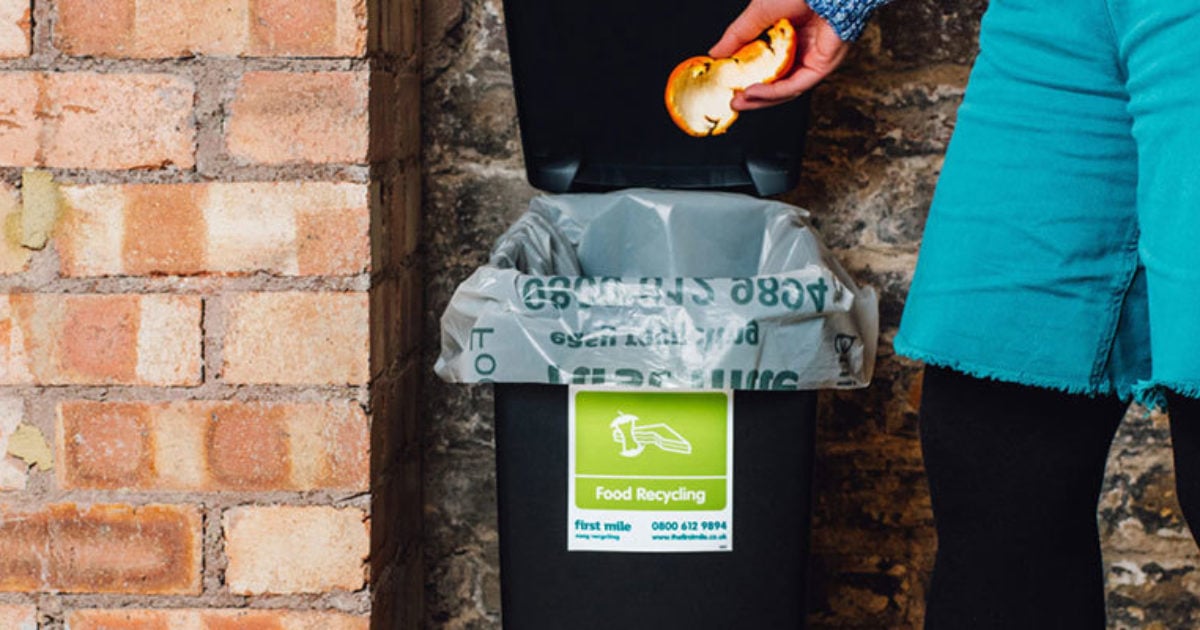
This is where food waste bins for restaurants really make a difference. Staff are far more likely to separate correctly when the bin is right where the waste happens.
Real-world examples:
- Restaurant kitchen: caddies beside prep benches for peelings and trimmings
- Hotel breakfast: a bin behind the buffet for scraping plates quickly
- Bar: small bins for garnish waste like citrus peel and coffee puck waste
Storage, hygiene and collections
Back of house, food waste is stored in larger, lidded wheelie bins until collection.
To keep things clean and pest-free:
- Keep lids closed
- Clean around the storage area regularly
- Match collection frequency to your volume of food waste
Typical collection frequency is based on how much waste you generate and how much space you’ve got. An experienced waste partner like First Mile can help you find the sweet spot between hygiene and cost.
Everything’s tracked digitally, giving you clear proof that your food waste is collected and handled correctly. That makes compliance easier and gives you solid data for reporting.
Common challenges for hospitality businesses (and how to overcome them)
In busy kitchens, the barriers to food waste separation are usually practical, but the benefits of recycling are huge. Here’s how to deal with the most common ones without adding friction to service.
Limited space
Space is tight in most kitchens. The fix is usually smarter placement, not bigger bins. Use smaller caddies where waste is created, then transfer to a larger back-of-house bin. More frequent collections can also reduce how much storage you need.
Cost concerns
Food waste is heavy. When it’s mixed into general waste, it pushes your general waste costs up and you’re more exposed to landfill-related costs. Separating food waste will reduce overall spend by cutting general waste volume and avoiding unnecessary disposal.
Staff training and compliance
Training doesn’t need to be complicated. It needs to be consistent.
- Show staff which bin goes where
- Put clear signage above bins
- Reinforce the “no packaging” rule
- Build it into induction and daily checks
Habits matter more than perfection. If your setup is easy, compliance naturally follows.
What happens to separated food waste?
Most food waste is recycled through anaerobic digestion.
This means food waste is broken down in sealed tanks without oxygen. It produces biogas, which can be used to generate renewable energy, and digestate, which can be used as fertiliser.
This is one reason food waste separation is so impactful. It turns a messy waste stream into something useful, and it avoids the worst environmental impacts of landfill.
Food waste separation and zero-to-landfill strategies
Zero to landfill doesn’t mean you produce no waste. It means none of your waste ends up in landfill.
Food waste is a big deal here because it’s heavy and high-impact. If you’re not separating it, your landfill diversion claims are harder to back up, and you’re likely paying more than you need to.
Getting food waste right supports:
- Stronger compliance and fewer contamination issues
- More credible sustainability reporting
- Lower carbon impact
- A clearer route to zero-to-landfill hospitality
First Mile helps you keep things simple, stay compliant, and prove diversion with clear reporting. If you want to see what that looks like in practice, take a look at First Mile’s service benefits.

Making food waste separation work
Food waste separation is now a core operational requirement for hospitality businesses. It protects compliance, supports cost control and strengthens your reputation.
The good news is it doesn’t have to be complicated. With the right bin placement, a simple staff routine, and a reliable collection partner, food waste separation becomes a natural part of service.
If you want help setting up compliant separation and moving towards zero-to-landfill with confidence, speak to First Mile about your options for food recycling and reporting.
FAQs about food waste separation in hospitality
Do small hospitality businesses need to separate food waste?
Yes. In England, most hospitality businesses must separate food waste, with micro-businesses under 10 employees having until 2027. Scotland and Northern Ireland have thresholds, and Wales introduced workplace rules in 2024, so it’s best to standardise across sites where possible.
Can compostable packaging go in food waste bins?
Not usually. Many compostable items aren’t accepted for anaerobic digestion. Only put them in the food bin if your waste provider confirms they’re allowed.
How often should food waste be collected?
It depends on volume, storage space and hygiene needs. Many hospitality sites choose two to five collections per week.
Are food waste macerators allowed?
Rules vary by nation and local guidance. Scotland restricts macerators where separate collection is available. If you’re unsure, check local requirements and speak to your waste provider.
What happens if food waste is put in general waste?
It increases costs, risks non-compliance, and makes it harder to prove recycling or zero-to-landfill performance. It can also lead to rejected loads if food contaminates other waste streams.