




The Deposit Return Scheme launches on 1st October 2027, and it will affect most retailers. Even if you're not required to operate a return point, you'll need to pay the 20p deposit if purchasing in-scope drinks wholesale.
This guide walks through what that means in practice for UK retailers: what DRS actually involves, which retailers must operate a public return point and which don't, your options for handling returns, manual counters, reverse vending machines, or container collection, what it costs and pays, the exemptions available, and how First Mile can help you prepare.
What is the Deposit Return Scheme?
From October 2027, a small deposit will be added to the price of every eligible drink sold in a single-use plastic or can container. Customers pay this deposit when they buy the drink and get it back in full when they return the empty bottle or can to any registered return point.
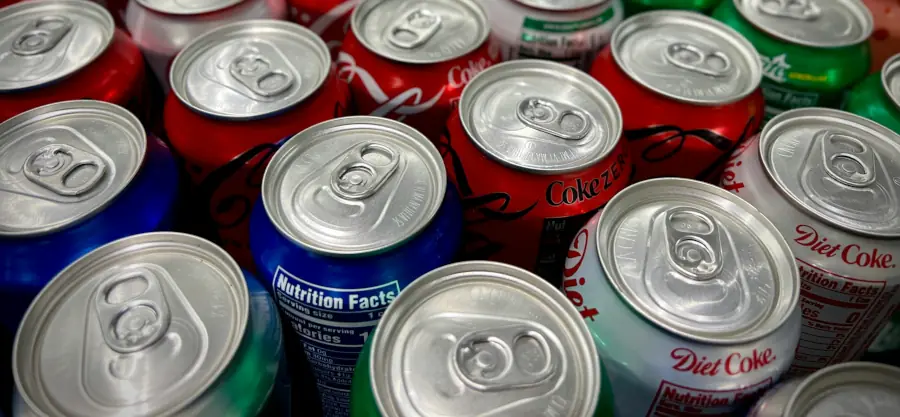
The system applies to plastic bottles and aluminium cans ranging from 150ml up to 3 litres. By giving containers a clear financial value, the government hopes to stop them ending up in landfill or as street litter and boost recycling rates across the UK.
If you're a retailer buying drinks wholesale, the 20p deposit will be built into what you pay your supplier for every in-scope can or bottle. This applies to any business purchasing drinks wholesale to sell on their premises.
Whether you're required to host a return point or not depends on what kind of retailer you are. But regardless of that, every retailer buying in-scope drinks wholesale is already paying the 20p deposit and needs to know whether to pass on the cost onto their customers, and how they will collect containers onsite to recoup the deposit.
Which retailers must operate a return point?
Required to HOST A RETURNS POINT: Grocery Retailers
Groceries retailers that sell in scope drinks to the public for consumption off the premises are required to host a return point open to the public, unless they qualify for an exemption. This includes supermarkets of any size, grocery stores, convenience stores, and newsagents that sell drinks.
Grocery retailers will need to register with exchange-for-change or apply for an exemption ahead of October 2027, and put in place a way to charge the deposit to customers, collect materials and refund the deposit at the point of return.
Not required to HOST A RETURNS POINT: Hospitality & food-to-go
Hospitality businesses including theatres, cinemas, pubs, hotels, restaurants & cafés, and food-to-go retailers like Pret, Joe & The Juice or Itsu, where in-scope drinks are sold, are not obligated to act as return points.
However, if selling drinks to be consumed off-site they will need to charge customers the 20p deposit. They will also need to register with exchange-for-change if they plan to host a returns point.
Not required to HOST RETURNS POINT: Online Retailers
Online retailers, including online only grocery retailers, have no mandatory obligation to operate a return point, though they can choose to register as a takeback service provider. Vending machine operators don't have to provide a return point either, but do have to display signage pointing customers to their nearest one.
What does DRS mean for retailers selling in-scope drinks?
If the drink leaves your premises, you will be required to charge the customer a 20p deposit at the till and pass the cost straight through. They can reclaim it themselves at any registered return point once they're finished with the container.
If the drink is consumed on site, you don't have to charge the customer, and in Scotland you're not permitted to. But, you've already paid the deposit to your supplier, so you will need a way to collect containers for return if you wish to recoup the cost. That means storing containers properly and returning them to exchange-for-change to be refunded, rather than treating it as a cost you simply absorb.
If you choose to collect containers consumed on-site you have several options. You can choose to charge the customer the 20p and host a returns point, returning the deposit to them once materials are returned. Or, you don't pass the cost on to customers consuming drinks onsite but still encourage containers to be returned onsite. You'll then to separate and collect these materials from your other waste to be returned for a refund.
If you are required to under the scheme, or choose to collect containers on site, you will qualify for a Return Handling Fee for accepting and storing containers, on top of recovering what you paid on your own wholesale stock.
Manual and automated return points, or separate container collection
There are two ways to operate a public return point, plus a third option to separate containers for collection:
-
Manually, where a member of staff accepts the container over the counter and refunds the deposit, or
-
Automatically, using a reverse vending machine that the customer operates themselves.
-
Separate container collection, where your waste or recycling provider collects your empty containers directly from site and reclaims the deposit on your behalf, no customer-facing refund required.
The first two count as valid public return points under the scheme, and both attract a handling fee at different rates (more on that below). Separate container collection is still a straightforward way to recover the deposit on drinks you've already paid for, particularly useful if most of what you sell is consumed on-site rather than taken away.
| Return type | Manual Returns | Reverse Vending Machine | Container Collection |
|---|---|---|---|
| How it works | Staff take the empty containers by hand and refund the deposit via the till. | Customers feed containers into a machine which issues a refund voucher. | Your provider collects empty containers from site and reclaims the deposit for you. |
| Best suited for | Smaller shops with lower footfall and limited floor space. | Larger stores expecting a high volume of returns. | Businesses where drinks are mostly consumed on-site, with no need to serve public returns. |
| Staff time | Requires staff interaction for every single return. | Fully automated, freeing up staff for other tasks. | Minimal, just keep containers separated ready for collection. |
| Storage | Containers must be safely stored in the back room by staff. | The machine crushes and stores the containers internally. | Containers are stored until your next scheduled collection. |
The return handling fee
If you operate a return point you are entitled to a Return Handling Fee (RHF). This is a payment to you designed to cover the cost of equipment, staff training, and the value of the floor space or storage area you use to collect and hold containers.
The rates are:
| Manual return points | 3p per container |
| Automatic return points, Tier 1 | 5p per container, for up to 225,000 in-scope items returned annually |
| Automatic return points, Tier 2 | 1.3p per container, for annual returns above 225,000 |
Container collections
Exchange for Change will arrange the physical transport from return points to counting and sorting centres, utilising contracted logistics and recycling infrastructure. Full details are not currently available.
Other considerations
Before deciding how to approach DRS, most retailers will need to think about:
| ⭐ | How much floor space or back-of-house storage you realistically have |
| ⭐ | Check your till provider to make sure your system can add and track the 20p deposit |
| ⭐ | How you'll store returned containers hygienically and securely before collection |
| ⭐ | Store and staff hygiene. With a risk of liquid spillages at both manual and automatic return points, staff need to be alert to avert slip risks. Containers may also be dirty, so having adequate hand washing facilities is important. |
| ⭐ | Staff time, particularly at busy periods, if you're going the manual route |
Does an RVM pay for itself?
ACS has publicly said its modelling suggests RVM fixed costs can exceed £10,000 per year and estimated roughly 4,000 containers/week (208,000 per year) would be needed to break even under its assumptions. Below is a simple illistrutive calculation to show what would be covered by the handling fee.
50 returns/day = 18,250 returns per year. RHF at 5p = £913/year.
250 returns/day = 91,250 returns per year. RHF at 5p = £4,563/year.
600 returns/day = 219,000 returns per year. RHF at 5p = £10,950/year.
First Mile offers a free DRS consultancy to help you prepare for the scheme. We also have a range of reverse vending machines available for purchase or lease.
Small retailer grant scheme
A £60m grant fund has been set aside by Exchange For Change to help up to 10,000 small independent retailers meet installation and maintenance costs of installing reverse vending machines.
Grants of £6,000 will be made available per site to qualifying retailers, paid in three £2,000 annual payments. The first payment will be issued three months after the installation of an RVM.
How your till ties into the scheme
Check with your till provider now to make sure your system can handle the scheme.
You will need your checkout system to automatically add the 20p deposit to the price of eligible drinks at the point of sale. It must also accurately track the deposits you refund to customers to balance the money taken in deposits against the money paid out in refunds.
Get a free DRS consultation with First Mile
Getting ready for DRS looks different depending on the size and layout of your business. First Mile works with retailers of every size to figure out the right approach for each site, from single independent shops to national multi-site chains.
We’re offering free DRS consultations to both customers and non-customers to help you prepare for the scheme. This includes:
| ✓ | Helping you understand what DRS actually means for your business, in plain terms |
| ✓ | Assessing the requirements of individual sites, including whether a site is likely to qualify for an exemption |
| ✓ | Helping you decide between a manual return point and an RVM, based on space, footfall and expected volumes |
| ✓ | Supporting manual return point implementation, from storage layout to process design |
| ✓ | Practical help with storage, layout and day to day processes ahead of launch |
We also supply reverse vending machines, built to suit retailers of any size, which are available to purchase or lease.
For qualifying small independent retailers, First Mile factors the £6,000 Exchange for Change grant into its buy and lease pricing for RVMs, rather than leaving you to wait on the staged payments Exchange for Change pays out over three years.
Return point exemptions
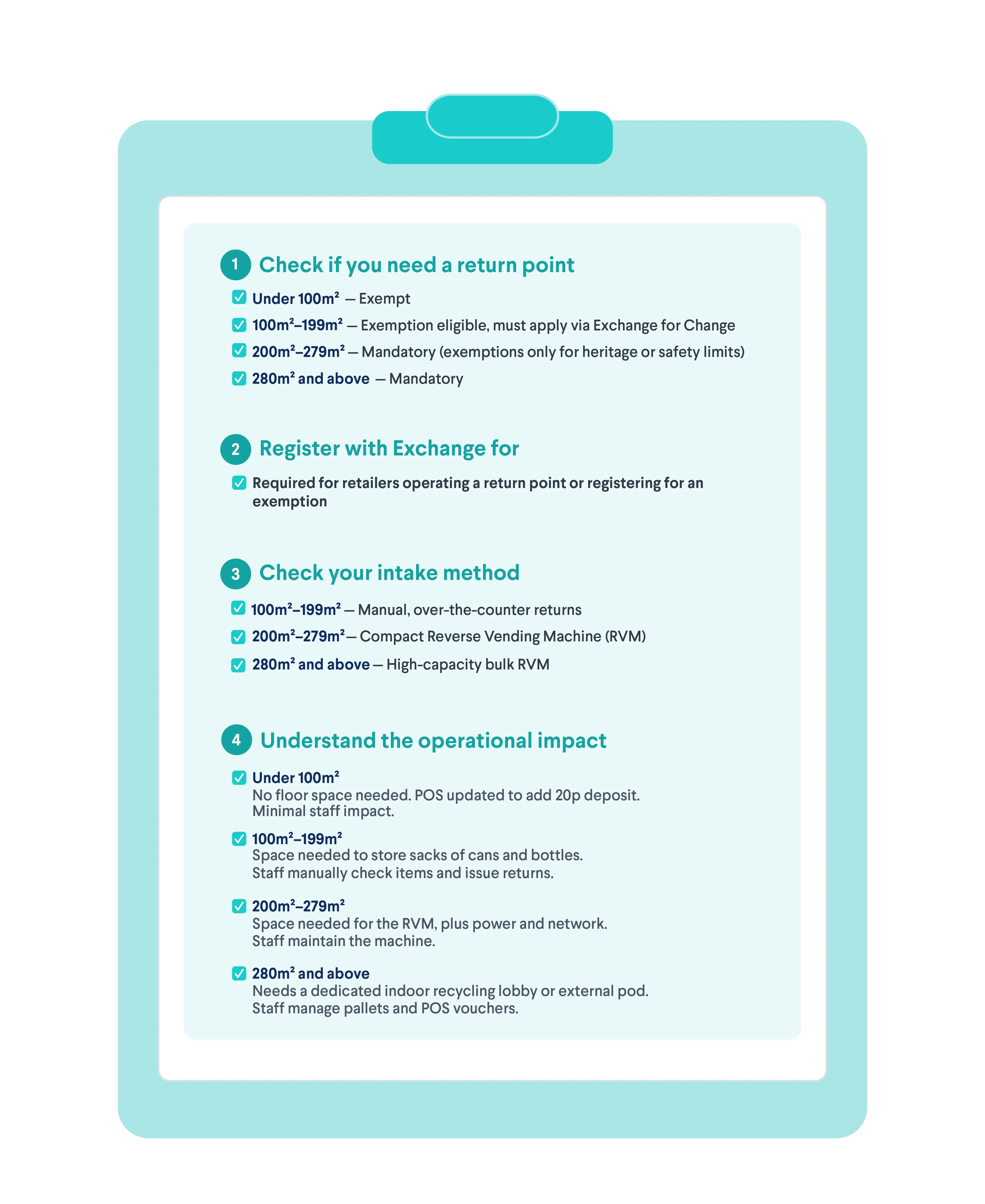
The exemptions process is designed to protect businesses that physically cannot manage a return point. Only urban stores under 100m² are automatically exempt.
| Your site | Likely position |
|---|---|
| Urban store <100m² | Automatically exempt |
| Urban store 100–199m² | May qualify for exemption |
| Rural store <200m² | May qualify for exemption |
| Larger retailer | Likely needs a return point |
| Hospitality / food-to-go | No mandatory public return point |
| Online-only | No mandatory return point |
The three main reasons you might be exempt are:
| Store size: Shops with a floor space between 100m² and 199m² (under 200m² for rural stores) can apply for size-based exemption. |
| Proximity: You can apply for an exemption if your shop is located very close to another official return point that has agreed to accept containers on your behalf. |
| Safety and layout: If the physical design of your shop makes it dangerous or completely impractical to store returned bottles, you may qualify for an exemption. |
Your return point duties
If you're operating a return point, your duties include:
| ✓ | Only selling in-scope drinks from producers registered with Exchange for Change |
| ✓ | Making sure everything you sell carries the correct scheme return code and DRS logo |
| ✓ | Charging the deposit on every in-scope container sold |
| ✓ | Accepting every in-scope container a customer brings back, regardless of where they bought it |
| ✓ | Refunding the deposit at the point of return |
| ✓ | Storing returned containers safely until they're collected |
| ✓ | Displaying clear information about how the scheme works, and how customers can raise a complaint or contact Exchange for Change |
Who needs to register with Exchange for Change
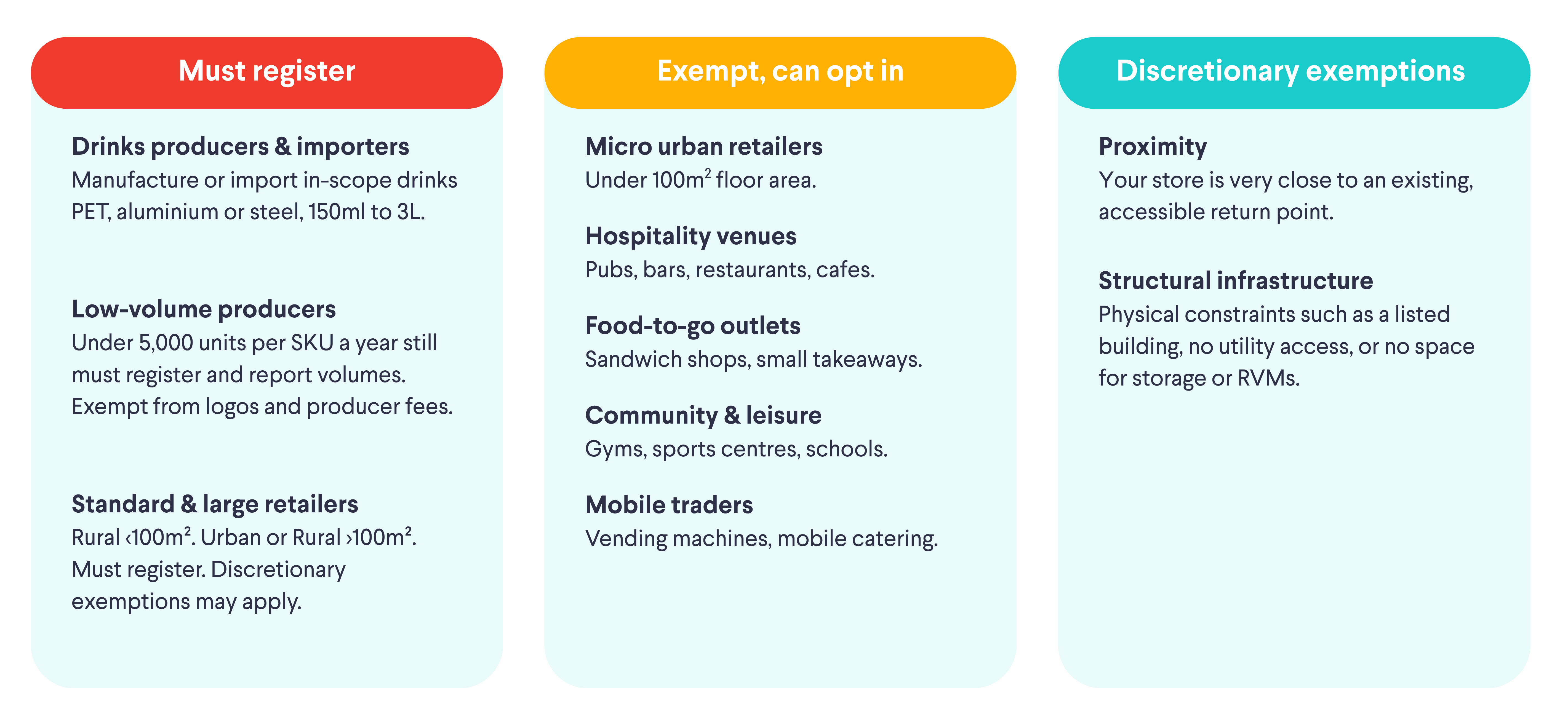
Exchange for Change is the official operator of the Deposit Return Scheme and some businesses need to register with them.
-
Grocery retailers: All but those who are automatically exempt
-
Producers and importers: Manufacturers and importers of drinks must register
-
Hospitality & food-to-go: No need to register at present
DRS Timeline
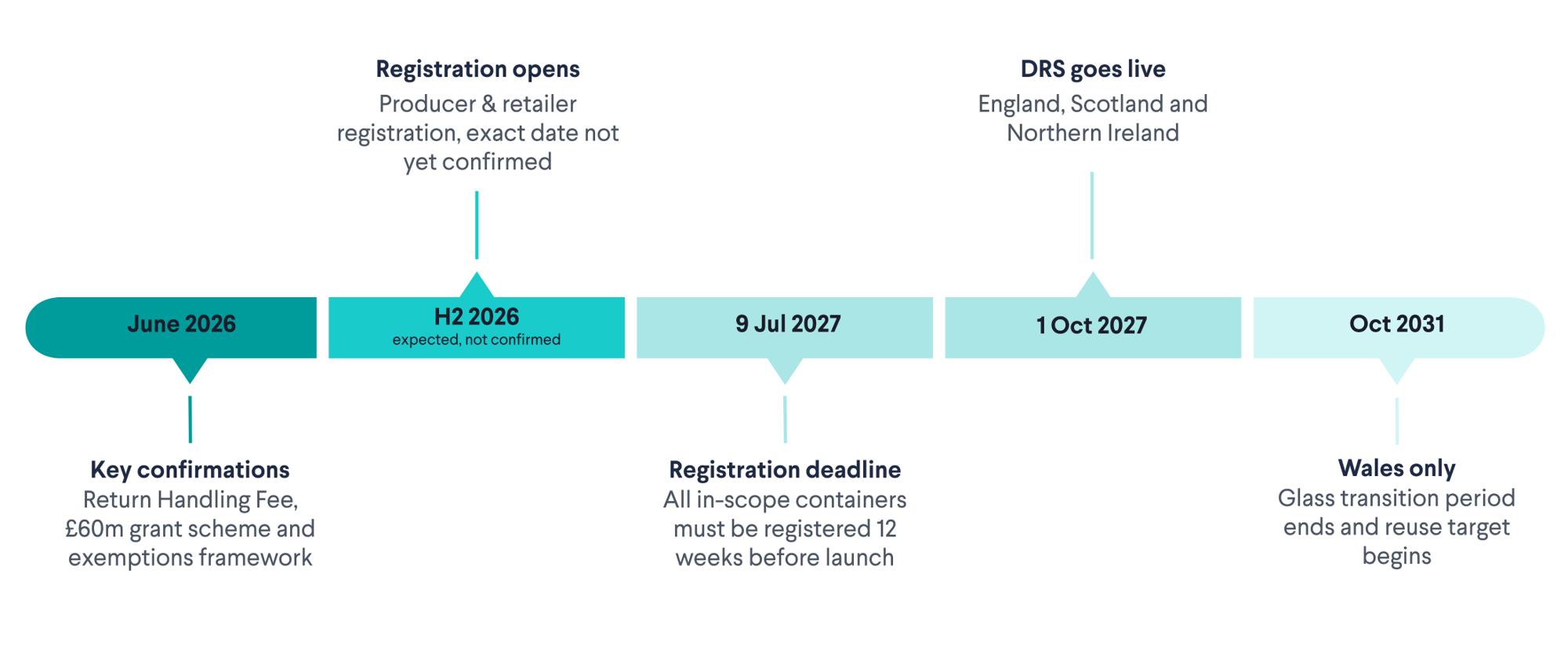
- June 2026
Key confirmations: Return Handling Fee, £60m grant scheme and exemptions framework.
- H2 2026
Registration opens for producers and retailers. Exact date not yet confirmed.
- 9 July 2027
Producer product-registration deadline. Producers must register all existing in-scope products with Exchange for Change 12 weeks before launch. Retailer registration will follow once Exchange for Change confirms the onboarding timetable.
- 1 October 2027
DRS goes live in England, Scotland and Northern Ireland.
- October 2031
Wales only: Glass transition period ends and reuse target begins.
Summary
What to think about now
Work out roughly which category your site falls into, automatically exempt, likely to need to apply for an exemption, or clearly required to operate a return point. Start weighing up a manual versus automatic process based on your space and expected volumes. First Mile can help you assess your sites and put the right solution in place.
It is also an opportunity to see increased footfall, so it is worth considering looking into impulse purchase options around your return point to maximise transaction potential.
What to think about when registration opens
Once Exchange for Change opens registration and publishes the exemption application process, you'll need to register, unless you are automatically exempt. Get your chosen return point installed and tested, and get staff trained on the process, all before October 2027.

Preparing your retail business for DRS?
Talk to First Mile about the right return solution for your business, whether that's a manual return point, a reverse vending machine, or help understanding whether you might qualify for an exemption.
Retailer DRS FAQs
How does a manual DRS return point actually work?
A member of staff accepts the empty container from a customer, checks it's part of the scheme (usually by scanning a barcode or checking the scheme logo), and refunds the deposit through the till. The container is then stored on site until it's collected. No machine is required, though you still need suitable storage space.
Do I have to install a reverse vending machine, or can I run a manual return point instead?
Either is a valid way to comply with DRS if you're required to operate a return point. Manual return points suit lower volumes and lower upfront cost, while an RVM takes day-to-day handling off your staff but comes with a bigger initial investment and space requirement. Which one makes sense depends on your site and expected footfall.
What is the Return Handling Fee and how much will I be paid?
It's the fee Exchange for Change pays retailers for operating a return point, intended to cover equipment, staff training and the use of your floor space. As confirmed in June 2026, manual return points are paid 3p per container. Automatic return points are paid 5p per container for up to 225,000 returns a year, dropping to 1.3p per container above that.
Is my shop automatically exempt from operating a return point?
If you're in an urban area and your retail space is under 100m², yes, you're automatically exempt and don't need to register unless you want to operate a return point voluntarily. Larger shops, and all rural shops regardless of size, need to either operate a return point or apply for one of the other exemption categories.
Can I apply for an exemption if my shop is between 100m² and 200m²?
Yes, in principle. Urban retailers with a retail space between 100m² and 199m², and rural retailers under 200m², can apply for a size-based exemption. It isn't automatic, and there's a presumption against granting exemptions to shops of 200m² or more. The full application and exemption process hasn't been published yet.
Is there financial help available for small retailers who need to install an RVM?
Exchange for Change has confirmed a £60m grant fund aimed at up to 10,000 small, independent retailers, offering £6,000 per site paid over three years. Detailed eligibility criteria are still to be published, expected in Q3 2026.
Who is running the scheme?
The scheme is run by Exchange for Change, the trading name of the UK Deposit Management Organisation (UK DMO), a not-for-profit body appointed to deliver DRS across England, Scotland and Northern Ireland. Wales is running its own, separate scheme with different rules and its own scheme administrator. Its legislation includes glass, but glass will carry a zero deposit during a transition period running to October 2031, meaning the October 2027 experience for consumers and businesses will be closely aligned with the rest of the UK at launch.
Why is DRS being introduced?
It's being introduced to cut litter and lift recycling rates. The scheme's own documentation sets out a target of returning 90% of all in-scope containers placed on the market by 2030, which is only achievable with a genuinely accessible, well distributed network of return points.
Sources:
-
Exchange For Change - Exchange For Change Announces DRS Support for Retailers, 10 June 2026
-
Exchange For Change - Return Point Exemptions Criteria, June 2026 (PDF)
-
Exchange For Change - Deposit Return Scheme Return Handling Fee, 2 June 2026
-
Exchange For Change - In-scope containers material specification
-
Exchange For Change - Supporting small, independent retailers: exemptions and grants
-
Exchange For Change - FAQs Glass exclusion
-
Exchange For Change - Exchange for Change confirms flat 20p deposit value for DRS
-
Exchange For Change - Hospitality and food-to-go businesses