






Waste legislation across the UK is changing quickly, and the expectations placed on businesses are shifting just as fast. Between new sorting rules, digital record keeping, and deposit schemes, facilities and sustainability managers face a growing list of requirements.
Our chief executive officer, Susan Davy, recently hosted the Future of Business Waste Webinar and was joined by a panel of business leaders to provide real world examples of how companies are managing and implementing processes in response to the changing waste legislation landscape.
Watch the full recording of Future of Business Waste: Lessons from our Customer Panel
Our invited panellists included sustainability and operations leaders from a variety of sectors:
-
Abigail Birtles, Sustainability Manager at Barnardo's, manages complex donation streams across 500 charity shops.
-
Sarah Rowell, Environment Health and Safety Manager at Knight Frank, oversees compliance and operations across more than 80 commercial offices throughout England, Scotland, and Wales.
-
Isaac Vale, ESG Manager at Here East, manages waste across a 1.2 million square foot campus home to over 30 businesses, six universities, and thousands of daily visitors.
-
Chris Tunesi, Retail Operations Manager at The White Company, embeds waste reduction, B Corp standards, and new recycling streams across 83 retail stores.
This article recaps the webinar and highlights what the likes of Barnardo’s and The White Company have done and plan to do in response to Simpler Recycling, Digital Waste Tracking and the Deposit Return Scheme.
Simpler Recycling: Why Waiting for Deadlines Costs More Than Acting Early
Simpler Recycling legislation has been in place for most English businesses since March 2025, requiring the separate collection of dry mixed recycling, food waste, and residual waste. Two key milestones remain on the horizon:
31 March 2027: Micro-firms (businesses with fewer than 10 full-time equivalent employees) must comply with the separate collection rules.
2030: Mandatory separation of flexible plastics, pushed back from the original 2027 target.
For full requirements and operational checklists, read our Simpler Recycling Practical Guidelines.
While a policy delay might sound like a reason to pause, our panellists demonstrated why moving ahead of the law delivers immediate financial and operational benefits.
The White Company: Turning a Regulatory Delay into a 30% Saving
When the government pushed mandatory flexible plastic collections back to 2030, The White Company chose not to wait. Chris Tunesi explained that all of their London stores that can physically host the service are already running a dedicated flexible plastics stream.
“We have a real appetite to make sure that we are doing the right thing, not just by our teams, but also by our customers... And regardless of what is happening with the legislation, that does not necessarily change how we approach it. All of our London stores that can have the waste stream already have it. They are testing it out for us at the moment... We know there is a 30% reduction in terms of cost versus our dry mixed recycling waste stream.”
Chris Tunesi, Retail Operations Manager, The White Company
By starting early, The White Company gains hands-on feedback from store managers, lowers waste collection costs, and protects its high recycling rates. Chris noted that their store managers keep them honest by speaking up whenever processes do not work smoothly back of house. That feedback loop ensures that when the 2030 legal deadline arrives, their stores will have run the process seamlessly for years.
The team has applied that same proactive mindset to other streams. They rolled out food waste across their shops last year to keep general recycling streams clean. They also introduced a take-back service for electronic fragrance diffusers, giving shoppers a like-for-like replacement in store while recycling end-of-life units, office printers, and break-room appliances through First Mile.
Knight Frank: High Baselines, Multi-Nation Rules, and Targeted Audits
Managing compliance across over 80 offices presents a different puzzle, especially when properties are spread geographically across the UK. Sarah Rowell explained that Knight Frank adopted a strategy of matching the highest standard across all regions. When Wales introduced stricter separation rules earlier than England, Knight Frank used that benchmark to align offices across the UK.
In addition to varying regional legislation, every building has distinct physical constraints:
-
Some high-street branches have no space for external bins, requiring sack collections that adhere strictly to local council time-bands.
-
Large multi-tenanted properties, such as their Baker Street head office housing up to 400 staff, require close coordination with building landlords to ensure waste facilities match tenant expectations.
Getting bins in place was only the first step. Sarah pointed out that the real challenge lies in keeping staff engaged once the initial launch settles:
“It is always about turning new requirements into workable actions for each office. You have to make everything easy for people, providing that training, really clear guidance, and telling people why... Our next approach is now audits so that we can check and see what each office is doing. Our (First Mile) account manager is starting to give us data on food waste so that we can see whether teams are still following the guidance.”
Sarah Rowell, Environment Health and Safety Manager, Knight Frank
Deposit Return Scheme: Turning an Obligation into an Opportunity

The UK Deposit Return Scheme (DRS) is scheduled to launch in October 2027. The scheme introduces a refundable 20p deposit on in-scope drinks containers, designed to drive up recycling rates and tackle litter.
Obligations for retailers depend directly on floorspace:
Under 100 square metres: Automatically exempt from operating a return point.
100 to 199 square metres: Must register and host a return point unless granted a specific exemption by Defra.
200 square metres and above: Obligated to register and operate a return point, with no exemptions.
Hospitality venues and office workplaces will generally be exempt from hosting a public return point. However, any organisation that purchases in-scope drinks will pay the 20p deposit upfront. Businesses must decide whether to pass this cost on to staff and customers, and how they will separate and return containers to reclaim those funds.
Our recent customer readiness survey revealed that 50% of retailers currently feel unprepared for DRS, largely because they are still assessing how the rules apply to their premises.
To see where your business stands, explore our Retailer Guide to the Deposit Return Scheme and our dedicated Deposit Return Scheme service.
Here East: Navigating a Campus of Over 30 Diverse Businesses
Here East is a 1.2 million square foot technology and education campus in East London. They manage waste for universities, retail units, restaurants, and the recently opened V&A Storehouse. ESG Manager Isaac Vale explained that while none of their campus tenants are large supermarkets with a mandatory requirement to take back bottles, all of them will feel the operational ripple effects.
Between 6,500 and 7,000 students, staff, and office workers move through Here East every day. If those individuals pay a 20p deposit on a drink purchased at an on-site cafe, they will expect a convenient way to recycle that container and recoup their money.
“We describe ourselves as London's unconventional campus, designed to be a place of innovation and collaboration. That gives us an opportunity to use the campus as a test bed... We are exploring whether we can do something centrally from a property management perspective, setting up a deposit return system on behalf of all the retailers and campus operators.”
Isaac Vale, ESG Manager, Here East
Isaac noted that a shared scheme brings operational questions, including how to allocate rebates fairly among food outlets and canteens. By starting conversations with tenants early, Here East aims to have a tested, smooth campus-wide system ready a full year before the scheme goes live.
Barnardo's: Reimagining Deposits as Charitable Donations
Barnardo's shops are not required by law to act as return points, yet Abigail Birtles sees the scheme as an opportunity rather than a regulatory burden. Working alongside their First Mile account manager, Barnardo's is exploring whether shoppers can choose to donate their 20p container deposit directly to the charity, or receive it as store credit to spend in their shops.
This approach turns a logistical compliance requirement into a creative fundraising channel that supports vital children's services.
Digital Waste Tracking: Replacing Paper Trails with Reliable Data
Digital Waste Tracking (DWT) is a UK government programme designed to replace paper waste transfer notes and hazardous waste consignment notes with a single electronic register. The rollout takes place in two distinct phases:
Phase 1 (1 October 2026): Applies only to waste receivers providing electronic data to Defra. First Mile customers do not need to take any compliance action for this phase, as we handle reporting on our end.
Phase 2 (October 2027): Applies to waste collectors, carriers, brokers, and dealers.
For an operational breakdown of duty of care obligations, see our Digital Waste Tracking Duty of Care Checklist and our Digital Waste Tracking service page.
Building Defra-Approved Compliance Software
To prepare for Phase 1, we invested heavily in our proprietary route management software, Miley. The system tracks every collection from customer doorstep to our weighbridges and sorting depots, automatically logging waste weights and types before transmitting the data to Defra via an API.
First Mile is the only waste provider that has developed its own Defra-approved, compatible DWT software from an operator perspective. Because the platform is built to handle multi-site collections and complex carrier routes, we are also making our software available to support other waste carriers and transport networks preparing for Phase 2.
Are you a waste receiver or carrier?
If you’re looking for a Digital Waste Tracking solution, contact us today to find out more.
See Miley in action and book a live demo with the First Mile team.Better Data for Internal ESG Reporting
While legal requirements for waste producers remain unset, businesses already need accurate, transparent waste metrics for stakeholder reporting and ESG audits. We recently overhauled our customer reporting portal to make this easier:
Location league tables: Compare recycling performance across branches, offices, or properties to spark healthy competition.
Custom data metrics: Upload headcount, revenue, or square footage to calculate waste output per employee or unit of floor space.
Flexible reporting units: Toggle between kilograms and metric tonnes, with full data export options and white-labelled report downloads featuring your company logo.
Methodology transparency: Clear audit trails showing precisely how carbon savings and recycling figures are calculated.
For Knight Frank, this level of reporting is vital. Sarah Rowell uses portal data to carry out targeted office audits, tracking whether local teams maintain separate food waste habits or need refresher training.
Barnardo's is also preparing for Phase 2 well ahead of the October 2027 deadline. Because they move unsold stock between shops and use local authority permits to dispose of unsellable donations at civic amenity sites, they operate legally as a waste carrier. Rather than waiting for the deadline, Abigail Birtles is collaborating with First Mile to build automated digital forms for drivers and shop managers to log movements directly into Defra's portal.
Four Lessons for Facilities and Sustainability Managers
Our customer panellists manage very different portfolios, but their experiences highlight four consistent principles for handling regulatory change:
- 01
Treat delays as a testing window, not a reason to stop. Whether rolling out flexible plastics three years early like The White Company or setting up digital waste logs ahead of schedule like Barnardo's, early adopters iron out operational kinks and protect their budgets.
- 02
Design rules around real-world building constraints. What works in a spacious out-of-town retail park will fail on a busy London high street with strict council collection time-bands. Assess physical storage, sack requirements, and landlord relations before buying bins.
- 03
Use audits and data to keep habits sticky. Introducing a new bin stream is straightforward, but keeping it free from contamination requires ongoing attention. Use portal data to spot site-level drop-offs and share progress with local teams.
- 04
Look for commercial value in compliance. Separating flexible plastics cut collection costs by 30% for The White Company, interrogating bin requests saved funds for Barnardo's charitable mission, and Here East is using campus DRS to improve tenant satisfaction.
Navigating environmental regulation does not have to be an administrative drag. Our chief executive officer, Susan Davy, set the tone in the webinar by pointing out that businesses should not have to become waste legislation experts. That is our job at First Mile: understanding what is coming, investing ahead of the curve, and helping you navigate change so you can focus on running your business.
If you missed the live discussion, you can watch the full webinar recording for deeper insights from our panel. You can also speak to your First Mile account manager or our compliance team to review your current setup.
When does the Deposit Return Scheme start, and do offices need reverse vending machines?
The UK Deposit Return Scheme launches in October 2027. Offices, hospitality venues, and small retail premises under 100 square metres are exempt from operating return points, meaning they do not need to install reverse vending machines. However, organisations will pay a 20p deposit on all in-scope drinks containers they buy for staff kitchens, canteens, or vending machines. To recoup those funds, businesses will need a system to separate and return containers via manual bagged collections or designated drop-off points.
Has Simpler Recycling been delayed for flexible plastics?
Yes. Defra has postponed the mandatory separate collection of flexible plastics from 2027 to 2030. However, the requirement for businesses to separate food waste, dry mixed recycling, and residual waste remains legally in force. Micro-firms with fewer than 10 full-time equivalent staff must have these core streams in place by 31 March 2027. Businesses like The White Company have already implemented flexible plastic collections ahead of the deadline to lower dry mixed recycling costs.
What is Digital Waste Tracking, and what do businesses need to do right now?
Digital Waste Tracking replaces paper waste transfer notes with an online Defra database. Phase 1 took effect on 1 October 2026, but it only applies to waste receiving facilities. If you are a First Mile customer, you do not need to take any action for Phase 1 because our collection routes and weighbridge data upload directly to Defra through our approved Miley software. Waste carriers enter the scheme in Phase 2 in October 2027, while any launch date for waste producers is still to be announced.
How can multi-site businesses maintain consistent recycling across different regions?
Waste regulations vary between England, Scotland, and Wales. Organisations like Knight Frank manage this by setting their internal company baseline to match the strictest nation, ensuring consistent standards across all sites. From an operational standpoint, facilities managers should review local council collection windows, evaluate bin storage limitations site by site, and use centralised portal reporting to audit site performance regularly.
How can businesses manage waste compliance across shared buildings or multi-tenant estates?
Success relies on close alignment between property managers and occupiers. At Knight Frank, managing large locations like their Baker Street head office requires coordinating directly with landlords while maintaining clear separation routines internally. On larger campuses, centralisation works best: Here East is exploring an estate-wide Deposit Return Scheme collection setup to remove the operational burden from its 30 tenant businesses.
Does Digital Waste Tracking affect organisations that transport their own waste between branches?
Yes. Businesses that move waste between premises or take unsellable items to local authority recycling centres are classified as waste carriers, bringing them into scope for Phase 2 in October 2027. Barnardo's is preparing ahead of time by developing automated digital forms with First Mile so shop teams and drivers can upload transfer records directly to Defra.
How can businesses handle specialist streams like electrical equipment without complicating daily operations?
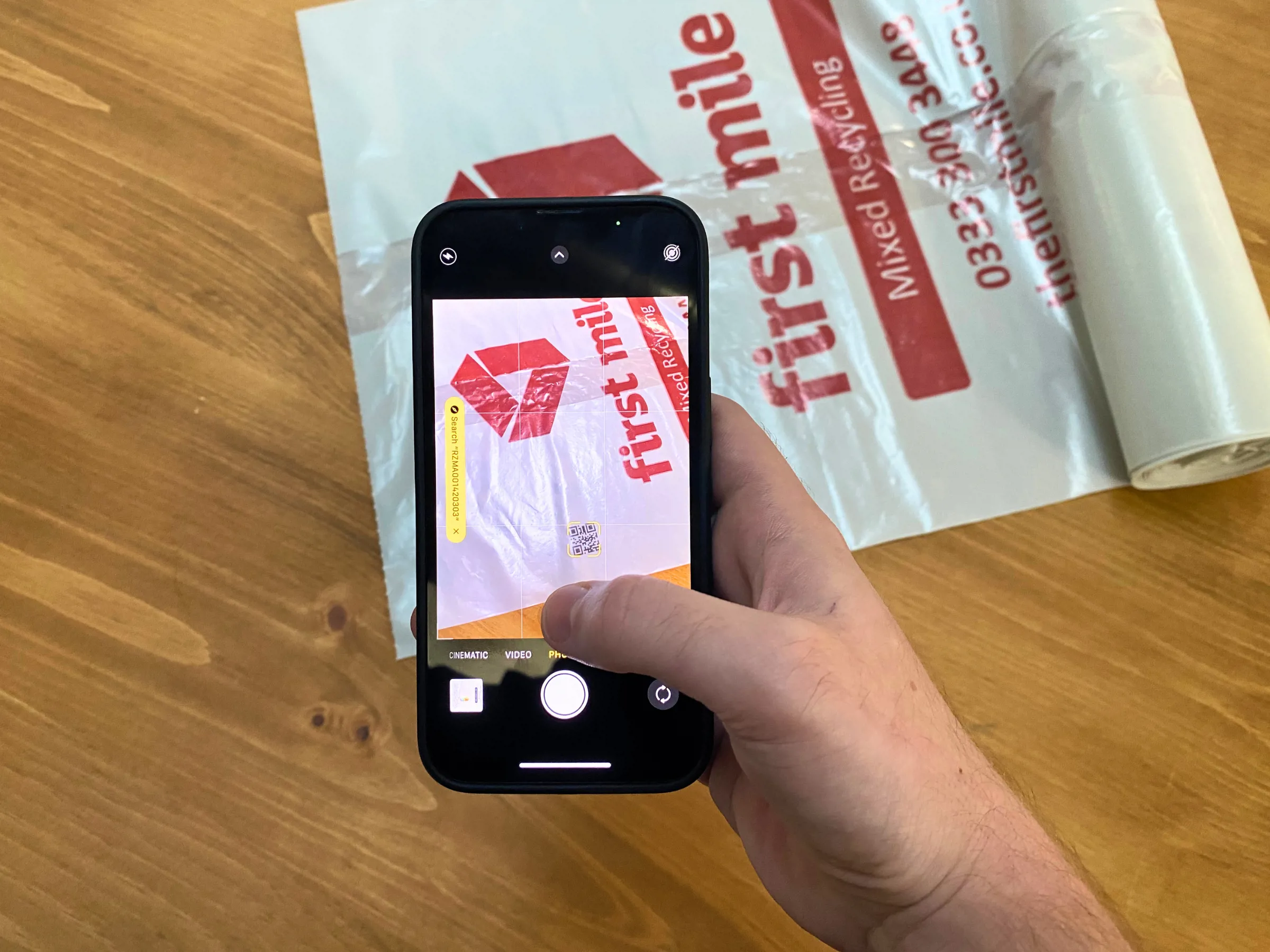
Specialist items like broken appliances and retail electronics cannot enter standard waste streams, but collection setups can remain straightforward. The White Company manages customer diffusers through an in-store take-back scheme, while back-of-house items like faulty printers and staff microwaves are collected via flat-fee boxes booked simply by scanning a QR code.

